Nobody Planned It — But It's the Thing That Holds Us Together
Somewhere around week three of the pandemic, the Kim family in Raleigh started doing something strange. Every Friday evening, they'd drag the old card table out to the garage, open the door to the driveway, and eat takeout from whatever local restaurant they were trying to support that week. It started because the kids were going stir-crazy and someone needed to feel like they were going somewhere, even if that somewhere was technically still home.
Four years later, they still do it. The pandemic ended. The card table stayed.
"We've done it through rain, through cold — we put a space heater out there in January," says their mom, Yolanda. "My daughter is in high school now and she will absolutely not let us skip it. It became this thing that was just... ours. I don't think any of us could have predicted that."
No one designed it. No one sat down and said, this will be our ritual. It just accumulated, week by week, until skipping it started to feel like something would be missing.
The Accidental Architecture of Belonging
We tend to think of rituals as intentional things — the traditions you plan, the holidays you observe, the milestone moments you mark with ceremony. But some of the most powerful rituals in people's lives aren't designed at all. They start as accidents. A practical solution to a specific problem. A thing that happens twice and then somehow keeps happening.
And over time, quietly, without anyone announcing it, they become load-bearing structures.
They become the thing that holds people together through the seasons when life gets genuinely hard — when someone loses a job, or a relationship falls apart, or a parent gets sick, or the world just feels like too much. The ritual doesn't solve any of those things. But it creates a container. A predictable place where people show up for each other without having to decide to, every single time.
The 6 a.m. Text
Brenda and her college roommate Jess haven't lived in the same city in fifteen years. They're in different time zones — Brenda in Phoenix, Jess in Boston. Somewhere along the way, during a period when both of them were going through difficult things at the same time, they started sending each other a text every morning. Not a long one. Sometimes just a word or two. A meme. A weather report. A complaint about coffee.
"It started because we were both struggling and we wanted to check in more," Brenda says. "But it kind of never stopped. We've done it for seven years now. If a morning goes by without a text from Jess, I notice. It feels off."
She pauses. "It's like — the ritual is the friendship now. The friendship lives in that ritual."
There's no agenda to the texts. No requirement to be deep or funny or even particularly coherent before 7 a.m. The only rule is showing up. And in that consistency, something profound has taken root: the certainty that someone, every single morning, is thinking of you.
The Kitchen Table That Holds the Hardest Conversations
Ask people where the important conversations in their family happen, and a surprisingly large number will name the same piece of furniture.
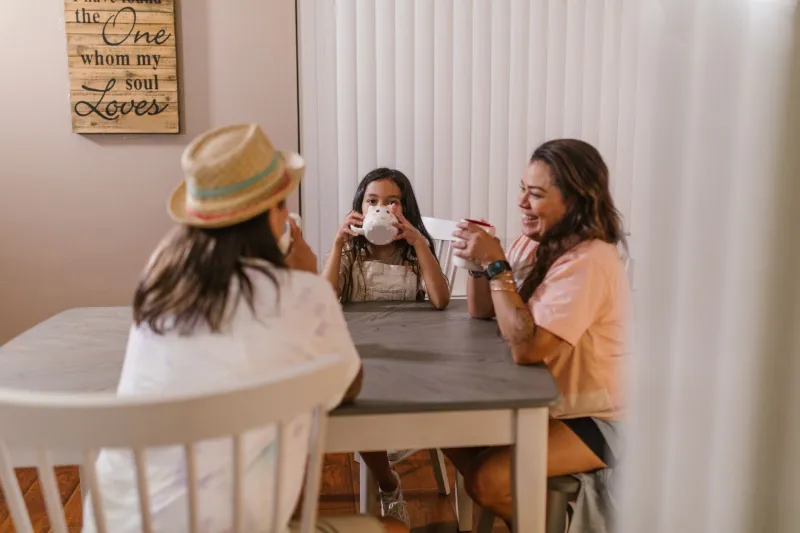
For the Okafor family in Houston, it's the kitchen table — specifically, after dinner on Sunday nights, when the dishes are done but no one has quite gotten up to leave yet. "That's where everything happens," says their eldest son, Emeka, now 26. "College applications, breakups, my grandma's health stuff, arguments, apologies. All of it happened at that table on Sunday nights."
It wasn't a rule. It wasn't scheduled. It just became the place where the family's guard came down — maybe because the meal had softened everyone, or because the low light made things easier to say, or because sitting together around food creates a kind of permission to be honest.
"My dad told us he was scared about money for the first time at that table," Emeka says quietly. "I'd never heard him say he was scared about anything. That was the place where it was okay to say it."
Why the Unremarkable Becomes Sacred
What's interesting about these rituals — the Friday garage dinners, the morning texts, the Sunday table — is that none of them are impressive on paper. They're not vacations or celebrations. They're repetitive, low-stakes, sometimes kind of mundane.
And that's precisely the point.
The power of a ritual isn't in its grandeur. It's in its consistency. It's in the fact that it happens whether or not everything is going well. Whether or not anyone feels like it. Whether or not there's anything particularly worth celebrating.
It shows up on the bad weeks too. And that's when it matters most.
When Rachel's husband was laid off last spring, the thing she credits with getting them through the worst of it wasn't a single conversation or a breakthrough moment. It was their Wednesday night walk — a thirty-minute loop around the neighborhood they'd started doing during a period when they were both trying to get more steps in and had simply never stopped.
"We walked every Wednesday," she says. "Even when things were really dark. Even when we didn't talk much. The walking was the talking, in a way. We were still moving forward together. That sounds cheesy but I mean it literally — we kept moving forward, side by side, every week."
Building One Without Knowing It
The thing about accidental rituals is that you can't manufacture them. You can't sit down and decide this will be our sacred thing. It doesn't work that way. The magic is in the accumulation — in the thing that starts for one reason and stays for a completely different one.
But you can notice them when they're forming. You can choose not to let them slip when life gets busy. You can honor the small, repetitive, unremarkable patterns in your relationships instead of dismissing them as just a habit.
Because here's what the Kim family in Raleigh knows, and what Brenda in Phoenix knows, and what the Okafor family in Houston knows: the thread that holds people together through hard seasons is usually not the grand gesture. It's the humble, consistent, showing-up-on-a-Tuesday kind of love.
The kind nobody planned. The kind that just, somehow, became the thing that holds everything else up.